Yelp AI Call Checks Your Restaurant Wait Time
 AI
Yelp's new AI call feature checks a restaurant's wait time for you and texts back the answer, no more guessing before you leave the house.
I have stood outside more restaurants than I can count, phone pressed to my ear, listening to a hostess shout over kitchen noise just to tell me "maybe twenty minutes" in a tone that meant forty-five. That particular small misery, the one where you have to make the call yourself and then immediately distrust the answer, is exactly what Yelp just decided to hand off to a machine.
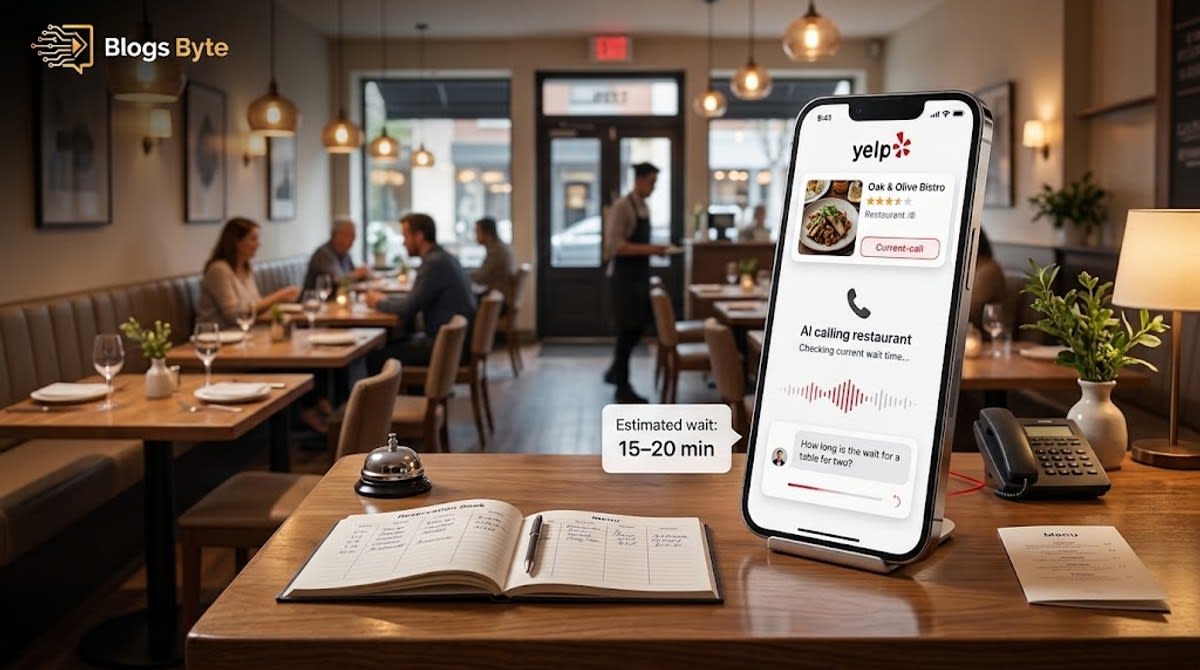
Yelp has launched a feature called Check for Me, an AI voice agent built into the app that calls a restaurant on your behalf to ask about the current wait, then texts you the answer. You open the restaurant's Yelp page, enter your party size and phone number, and the agent makes the call for you. A few minutes later, a text arrives, and you decide whether it's worth leaving the house.
If the whole idea of an app making phone calls on your behalf still sounds like science fiction, it helps to step back to basics: how AI actually works underneath a feature like this is mostly pattern-matching on speech, trained on enormous amounts of conversation, not genuine understanding the way a human host understands you. That distinction matters more once you hand the same system a phone and a real task to complete.
How yelp ai call restaurant wait time actually works
The flow is about as simple as these things get, which is probably the point. From a restaurant's Yelp listing, you tap into the feature, give it the number of people in your group, and confirm the phone number where you want the result sent. From there, Check for Me places the call itself, speaks to whoever picks up on the restaurant's end, and relays the wait time back to you as a text message rather than making you sit through the call live. You never actually talk to the restaurant. The AI does, and then reports back.
It's a small design choice that matters more than it looks: by texting the result instead of patching you into a live call, Yelp sidesteps the awkwardness of an AI voice suddenly handing a phone conversation over to a confused human, and it also means you can fire off the request and keep doing whatever else you were doing until the answer lands.
Part of a bigger wave, not a Yelp-only idea
Yelp isn't inventing the concept of an AI agent that makes phone calls for you; it's joining a wave that's already forming around exactly this idea, alongside AI calling assistants like Instinct and Fo, and alongside Meta's own Muse, which has been pushed hard toward exactly this kind of behind-the-scenes task handling. Muse, as it happens, has had quite a month of its own: it just crossed 10 million downloads in its first 40 days, a milestone most apps never reach at any speed, and that kind of scale means a lot more people are about to get comfortable with an AI agent making decisions and phone calls on their behalf, not just answering questions in a chat window.
That shift, from "AI that answers what you type" to "AI that goes and does something out in the world for you," is the real story underneath Check for Me. A chatbot that explains how wait times usually work at your favorite restaurant is a parlor trick next to one that actually places a real phone call, talks to a real host, and gets a real, current answer. Meta's push into agent territory hasn't stopped at Muse itself, either; the same month it released Muse Spark Open, an unusually open-weight model by the company's own standards, which tells you this isn't a side experiment Meta might quietly drop, it's a direction the whole company is leaning into from more than one angle at once.
It also fits a pattern that's shown up across more than one Meta product this year: handing more direct control and convenience to the person on the other end of the app, the same instinct that led Facebook to let users reshape their own feed algorithm instead of leaving every decision to a black box. An AI that calls a restaurant for you is a small version of the same idea, control over an annoying task handed back to the person who actually wanted the answer in the first place, rather than being quietly automated away from them entirely.
Why this fixes a genuinely annoying problem
The old way of finding out a wait time at a restaurant you haven't called before had exactly two options, and both were bad: show up and hope, or call yourself and awkwardly compete with whatever's happening on the other end of the line, a slammed Friday night host stand, someone who barely speaks your language, a landline buried somewhere in the back of the kitchen. Neither option gives you a reliable number, and both cost you something, either your evening plans or a slightly stressful phone call squeezed in before you leave.
Check for Me removes the second kind of friction entirely. You're not competing for a host's attention anymore; the AI is, and it's patient in a way a hungry person standing in their kitchen at 6:45 on a Friday rarely is. This is the unglamorous, practical end of AI that actually shows up in real world applications of AI rather than in a keynote demo: nobody's going to put "called a restaurant to ask about wait times" in a product launch video, but it's exactly the kind of small daily task that quietly earns its keep.
What Yelp didn't say, and why that matters
To Yelp's credit, nothing about Check for Me is overhyped in the way it's been announced. But a few obvious questions go unanswered in the rollout: which cities and restaurants are actually covered isn't specified, whether the feature costs anything isn't said, and the exact AI model or voice technology behind the call isn't named. For a feature this new, that's not unusual, companies often ship quietly and fill in details as coverage expands, but it's worth being upfront that a lot of this is still unconfirmed outside of what Yelp has shown in the initial rollout.
There's also a genuinely interesting limitation buried in the announcement itself: restaurants increasingly have their own AI agents answering the phone, and Yelp's own reporting on the feature flags that agent-to-agent communication might break down the conversation entirely. Picture two AI voices, one representing you and one representing the restaurant, trying to negotiate a wait-time answer between themselves. It's not a hypothetical edge case; it's the direction every business phone line is already heading.
The agent-to-agent problem nobody's solved yet
That specific risk, one company's automated system trying to talk sense out of another company's automated system, is a small preview of something developers have already been wrestling with in a different context. Anyone who followed Cloudflare's acquisition of the Deno team and the wave of people asking is Deno dead already knows this feeling: the tools and services you build around can change shape or behavior underneath you with no warning, and you don't get a vote. An AI agent calling a restaurant is relying on whatever that restaurant's own AI agent decides to do that day, built by some other company entirely, running code you'll never see, and there's no guarantee the two systems were ever designed with each other in mind.
It's the same underlying question Satya Nadella raised when he argued AI needs a kill switch: once software starts acting on your behalf out in the world, making calls, booking things, negotiating small outcomes, who's actually responsible when two of those systems collide and produce a wrong answer? Nobody's really solved that yet, and Check for Me is a small, low-stakes place where the problem is already visible if you look for it.
How this fits Yelp's bigger AI push this month
Check for Me didn't arrive alone. In the same update, Yelp's AI assistant picked up OpenTable integration for booking a table without leaving the app, started remembering preferences from earlier conversations, and now keeps thirty days of chat history, with a longer memory window reportedly coming. That's a meaningfully similar direction to the ongoing argument over NotebookLM vs ChatGPT, where the real differentiator increasingly isn't which assistant answers better in isolation, but which one actually remembers you and builds on a conversation rather than starting cold every single time.
Yelp also rolled out "Been Here" and "Want to Go" lists you can filter, annotate, and share, alongside a paid business-side tool called Smart Lead Reply that automatically responds to customer inquiries for $30 a month, putting Yelp in the same lane as Meta, which is pushing similar AI-drafted reply tools for small businesses through WhatsApp's own expanding feature set. Two very different companies, the same instinct: hand small businesses an AI that handles the first reply so a human only has to step in when it actually matters.
What this means if you're the one calling, or the one getting called
If you're a diner, Check for Me is low-risk: worst case, you get an answer that's a few minutes out of date by the time you arrive, same as it's always been with phoned-in wait times. If you run a restaurant, it's worth knowing your host stand may start fielding more automated calls than human ones, and that an answer given confidently by an AI voice carries the same expectation of accuracy a human staffer's would, even though it's working from whatever your team happens to say in that exact moment.
Either way, this is one more small sign of where the broader AI race is actually headed next, beyond chatbots, and closer to the question running through every comparison of Gemini 4 Argon, GPT-6, and Muse Spark Open: not just which model answers a question better, but which one you'd actually trust to go do something on your behalf and come back with the truth.
The bottom line
Yelp's Check for Me feature solves a small, specific, genuinely annoying problem: not knowing how long you'll wait somewhere without calling yourself and hoping for a straight answer. It's not flawless, the agent-to-agent risk is real, and plenty of basic details are still unconfirmed, but the core idea, let an AI make the annoying phone call so you don't have to, is exactly the kind of quiet convenience that tends to stick around long after louder AI features get forgotten.
FAQs
Does Yelp call restaurants for you?
Yes. Yelp's Check for Me feature places an AI-voice phone call to a restaurant on your behalf to ask about the current wait time, then texts you the result instead of connecting you to the call directly.
How do I use Yelp's AI calling feature?
Open the restaurant's page in the Yelp app, enter your party size and the phone number where you want the result sent, and start Check for Me. The AI places the call and texts you back once it has an answer.
How does Yelp check wait times without me calling myself?
An AI voice agent calls the restaurant directly and asks about the current wait, the same question you'd ask yourself, then relays whatever the restaurant's staff says back to you as a text message.
Does Check for Me work at every restaurant on Yelp?
Yelp hasn't specified which cities or restaurants are covered, so availability may vary. It's reasonable to expect coverage to expand over time as the feature rolls out more broadly.
Is Yelp's Check for Me feature free to use?
Yelp hasn't stated whether there's a cost attached to Check for Me itself, separate from the paid Smart Lead Reply tool it offers to business owners. Check inside the app for current pricing before relying on it.
Blogs Byte explains AI, software and productivity in plain English, and builds free browser-based tools.